

Photo Credit: Otautahi Christchurch Website
Will the 2026 New Zealand election change the property market? And should you buy, sell, or wait until after the election?
With the NZ General Election approaching on 7 November 2026, homeowners, first-home buyers, and property investors are asking one important question: What will happen to New Zealand house prices?
From potential capital gains taxes to housing policies and interest rates, the next government could influence the decisions New Zealanders make about property.
In this episode of Real Talk, Nathan Najib from Najib Real Estate explores how elections can affect the housing market, what current property statistics reveal, and what buyers and sellers should consider before making their next move.

New Zealand's property market has experienced significant changes over recent years, from rising mortgage interest rates to changing buyer demand and house prices.
Now, with the 2026 NZ General Election approaching, uncertainty surrounding housing and tax policies is creating another important consideration for buyers, sellers, and investors.
But does a change in government automatically mean a change in property prices?
Not necessarily.
The housing market is influenced by several factors:
Understanding these factors is essential before deciding whether to enter the property market.
The short answer is yes, but not always in the way people expect.
Elections can influence property market confidence, investment decisions, and housing policies. However, election results alone do not determine whether house prices rise or fall.
Some buyers delay purchasing until election results are announced.
Sellers may reconsider their timing because of uncertainty.
Investors may wait for greater clarity around taxation and property regulations.
Proposed capital gains taxes may influence investment decisions.
Changes to mortgage interest deductibility can affect landlords' after-tax returns.
Land taxes and other property-related taxes may influence ownership costs.
Planning reforms can make it easier or harder to develop housing.
First-home buyer support can affect purchasing opportunities.
Government investment in infrastructure and housing can influence long-term supply.
Will house prices fall after the election?
There is no guarantee.
Even if a new government introduces different housing policies, property prices will continue to respond to mortgage rates, employment, household incomes, and local supply and demand.
The key takeaway: Rather than trying to predict the election's impact on house prices, focus on the economic conditions and property market fundamentals.
Before examining the political parties, it's important to understand where the New Zealand property market currently stands.
According to the Real Estate Institute of New Zealand (REINZ), September 2026 recorded the following national property statistics:
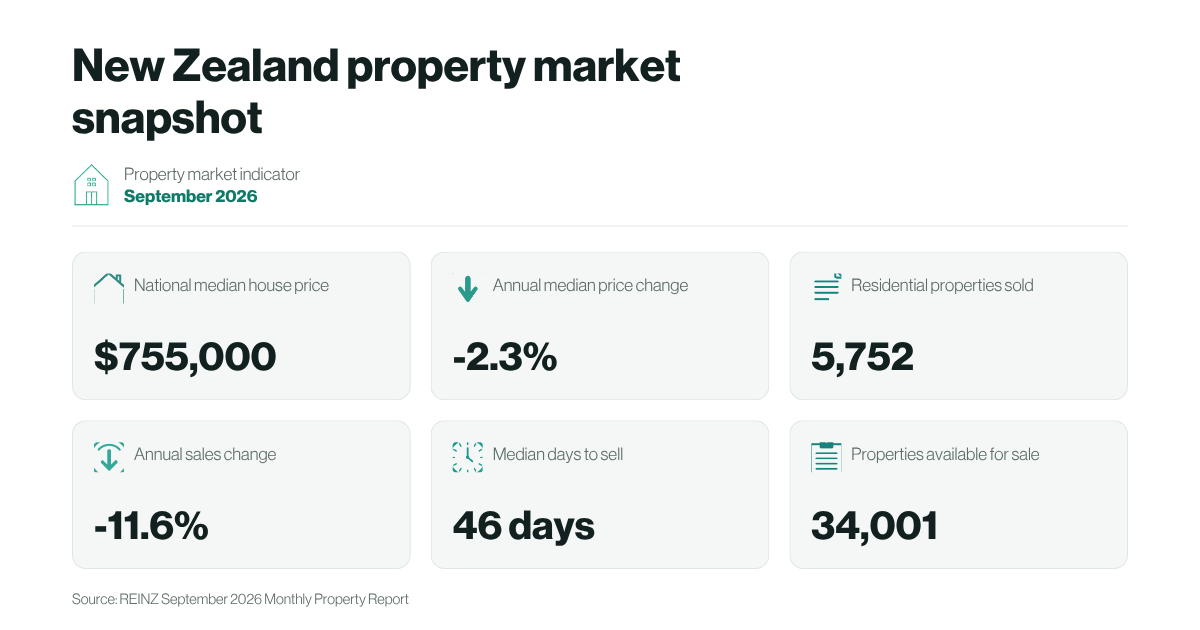
Source: REINZ September 2026 Monthly Property Report.
These figures suggest that buyers remain selective, with more properties available and longer selling times than a year earlier.
However, the market is not performing equally across New Zealand.
Christchurch property market continues to attract interest from buyers and investors looking for housing opportunities outside Auckland.
Canterbury's regional median house price reached $715,000 in September 2026.
This represented a 0.8% annual increase.
Canterbury's House Price Index increased 3.1% year-on-year.
For Christchurch and Selwyn homeowners, these figures reinforce the importance of understanding local market conditions rather than relying solely on national headlines.
Auckland remains one of New Zealand's most closely watched property markets.
Auckland's median house price declined 2.6% year-on-year in September 2026.
Buyers continue to consider affordability, financing costs, and available housing stock.
Individual suburbs can perform differently from the wider Auckland market.
Wellington has experienced a more cautious property environment.
Wellington recorded its third-lowest September sales count in the REINZ historical series.
Some districts experienced annual price increases despite subdued regional activity.
Employment conditions, mortgage affordability, and buyer confidence remain important considerations.
What does this mean for sellers?
Your property's value depends on much more than the election. Recent comparable sales, local competition, property presentation, and pricing strategy all influence the final selling price.
Photo Credit: RNZ 2026
Housing affordability, property taxation, and investment regulations are important issues in the 2026 New Zealand election.
Here's a simplified breakdown of key housing-related proposals from the major political parties.
National's housing approach focuses on increasing supply, reducing regulatory barriers, and supporting homeownership.
Key positions include:
Labour has proposed changes affecting property investors alongside increased investment in public housing.
Key proposals include:
The Green Party's proposals focus on housing affordability, tenant protections, and changes to property taxation.
Key proposals include:
ACT generally supports deregulation, reduced government intervention, and measures intended to encourage development.
Its broader approach includes:
Other political parties are also contributing to the housing debate.
New Zealand First: Has focused on household living costs and economic policy, alongside its positions on housing and investment.
The Opportunity Party: Proposes an annual land value tax of 1.75% on urban land and 0.5% on rural land, subject to its proposed exemptions and deferral arrangements.
Important: These are election proposals, not guaranteed changes to the law. The policies ultimately implemented will depend on the election outcome, coalition negotiations, and legislation.
The biggest mistake buyers and sellers can make is assuming that the election alone will determine the future of house prices.
While government policies can influence the property market, your decision should be based on your circumstances and local market conditions.
Research recent comparable property sales in your suburb.
Understand current buyer demand and competing listings.
Consider how long similar properties are taking to sell.
Develop a pricing and marketing strategy suited to the current market.
Understand your borrowing capacity and mortgage repayments.
Research median house prices in your preferred suburbs.
Compare properties based on value, location, and long-term suitability.
Avoid making decisions based solely on political predictions.
Review potential changes to capital gains tax and interest deductibility.
Assess rental yield, expenses, and cash flow.
Consider the long-term implications of different housing policies.
Seek independent tax and financial advice before making investment decisions.
Ultimately, the best time to buy or sell isn't necessarily before or after an election. It's when the numbers, market conditions, and your personal circumstances make sense.
The New Zealand property market is constantly changing, but understanding what drives those changes can help you make more informed decisions.
At Najib Real Estate, we help Christchurch and Selwyn homeowners navigate the property market with local knowledge, market insights, and strategic selling advice.
Whether you're considering selling your home, purchasing your next property, or simply wanting to understand what your property could be worth, our team is here to help.
Want to know what your property could sell for in today's market?
Get Your Free Property Performance Report
Or watch Nathan Najib's latest Real Talk episode: Thinking of Selling Your House Before the NZ Election? Watch This First
Stay informed. Make smarter property decisions.
Najib Real Estate | Christchurch & Selwyn
Disclaimer: This article is for general information only and does not constitute financial, legal, tax, or investment advice. Property market statistics reflect the reporting periods stated. Political policies are proposals as at November 2026 and may change. Readers should seek appropriate professional advice before making property decisions.